A gravel driveway in Pine Plains came to us the way a lot of them do: the surface had worn down to almost nothing, the stone that was left kept pushing toward the lawn, and every hard rain left a fresh set of ruts. The owners had been told a few different things about what to put on top of it. The honest answer was that the top was never the problem.

Why resurfacing would not have fixed it
When a driveway has gone this far, spreading new stone over the old one is money that washes away by spring. The old surface has no shape left in it, so water sits on it and runs down it instead of off it. New stone on top of that just follows the same path the old stone took.
This one got taken down to a firm base and built back up the right way: fresh crusher run, graded with a crown down the middle, and rolled tight so the stone dust locks the pieces together into a hard surface. That is the difference between a driveway that holds a plow and one that comes apart under it.
The culvert at the road was the real job
Here is what the owners were not originally quoting against, and what actually decides whether this driveway lasts. The road ditch sends water straight across the driveway entrance. With nothing to carry it under, every storm turned the bottom of the driveway into a creek bed and took the stone with it.

We set a new culvert across the entrance on a bed of stone, pitched so the water keeps moving and does not sit in the pipe. The outlet end got armored with rip-rap, because water coming out of a pipe with some speed behind it will dig a hole wherever it lands if you let it. The stone takes that energy out and lets the water spread into the ditch.
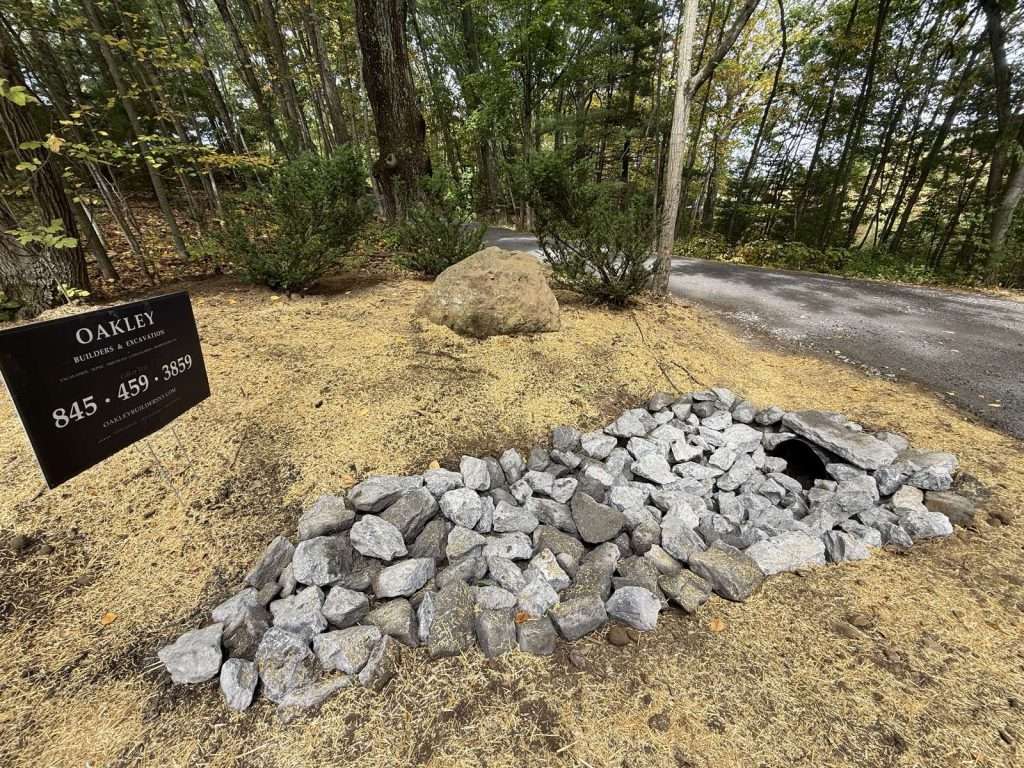
A swale where the water actually runs
The other piece was a drainage swale cut along the edge of the driveway, but only along the stretch where water actually runs. Not the whole length for the sake of it. A swale gives the water a lower place to go than the driveway, so it leaves the surface at the edge instead of gathering speed down the middle. Together with the crown, that is what keeps the new stone where we put it.
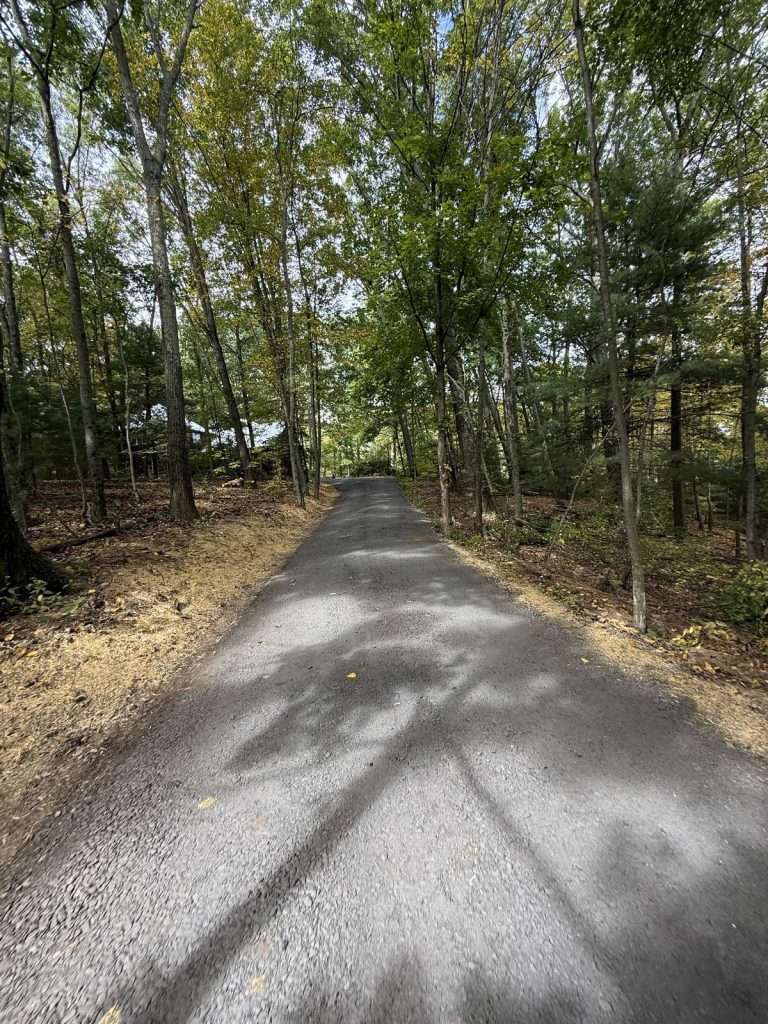
Crusher run, not washed stone
One thing worth clearing up, because it comes up on almost every driveway job. The owners had been shown a rounded, screened stone and told it was what they were getting. That is a drainage stone. It is a good product behind a wall or around a pipe, anywhere you want water running straight through and nobody driving on it. On a driveway it never firms up, because round stone rolls instead of knitting together, and on a grade it works its way downhill into the lawn.
Crusher run is crushed, so every piece is angular, and the stone dust is left in it. Graded and rolled, the dust fills the gaps and locks the whole thing up into a hard, crowned surface that sheds water. Names get used loosely from one yard to the next, so it is an easy mix-up. It is also the mix-up that costs people a driveway.

What to look at on your own driveway
If you are in Pine Plains, Stanfordville, Millerton or anywhere in northern Dutchess and your gravel driveway keeps washing, look at three things after the next hard rain. Where does the water enter the driveway from the road? Does it run down the middle or off the edges? And where does it come out at the bottom? The answers tell you whether you need stone, or whether you need a culvert and a swale first and then stone. Nine times out of ten it is the second one, and the stone lasts because of it.
Two more driveway rebuilds from this season if you want to compare: a long gravel drive in Millbrook where the grade and compaction were the whole story, and another Pine Plains driveway where a swale alone solved the washout.
Get a free ballpark without waiting for a visit. Text or email us photos and the property address, and we’ll come back with an honest range — within 24 hours. On-site estimates happen on Fridays, once the project details are in.
Oakley Builders & Excavation is family-owned out of Pine Plains, fully insured, and rated 5.0 stars on Google by neighbors across Columbia County and northern Dutchess — Valatie, Chatham, Millerton, Stanfordville, Rhinebeck, Milan, Copake, Ghent, Red Hook and the towns in between. All of this falls under what we call gravel driveway work and drainage and culvert work, and on a driveway like this one they are the same job.
Here is the easiest way to find out where you stand. The next time it really rains, take a photo of the bottom of your driveway where it meets the road, a photo of the worst stretch, and send them with the address. We’ll tell you honestly whether it needs a rebuild or whether the water just needs somewhere to go. Call or text Travis at 845-459-3859.